How 5-Band Resistor Color Codes Work
A 5-band resistor provides more precise resistance values by including a third significant digit. Here’s what each band represents:
- 1st Band (a): First significant digit
- 2nd Band (b): Second significant digit
- 3rd Band (c): Third significant digit
- 4th Band (d): Multiplier
- 5th Band (e): Tolerance
The resistance value is calculated using the formula: Resistance = abc × 10d (Ohms)
Resistor Color Code Chart
Each color in a resistor band corresponds to a specific value:
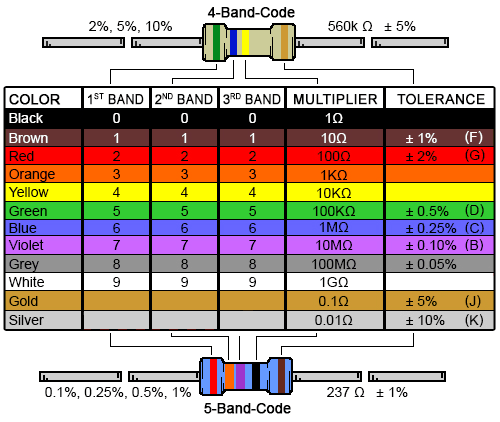
How to Calculate 5-Band Resistor Values
Let’s walk through the calculation process with an example:
Example: Brown-Green-Red-Black-Gold
- 1st Band (Brown): a = 1
- 2nd Band (Green): b = 5
- 3rd Band (Red): c = 2
- 4th Band (Black): d = ×1 (multiplier)
- 5th Band (Gold): e = ±5% (tolerance)
Applying the formula: Resistance = 152 × 1 = 152 Ohms with ±5% tolerance
This means the actual resistance could range from 144.4 Ohms to 159.6 Ohms.
Using Our 5-Band Resistor Color Code Calculator
Our online calculator makes it easy to decode resistor values. Here’s how to use it:
- Select the number of bands: Choose “5-Band” from the resistor type selector
- Select the colors: Click on each band position and choose the appropriate color
- View the result: The calculator will instantly display the resistance value and tolerance
Alternatively, you can:
- Enter a specific resistance value: Type your desired resistance
- See the colors: The calculator will show which color bands would represent that value
Reading Direction for Resistor Color Codes
To correctly read a resistor, first identify the tolerance band (typically gold or silver), which is usually the last band on the right. If there’s no gold or silver band, look for the band that’s spaced little distant from the others – this is typically the tolerance band.